How do you reverse a campervan?
To reverse a campervan safely, first check your mirrors and surroundings, secure loose items inside the vehicle, and use a spotter or reversing camera if available. Reverse slowly while checking both sides of the campervan, the rear and the front corners. If you lose visibility or are unsure of your position, stop, reassess and continue only when the path is clear.
Reversing a campervan (or reversing an RV) is easier than reversing a car with a boat trailer, once you know the things to check before you start and the step by step process of what to do while reversing a campervan. This handy guide explains the process clearly, so you will be able to confidently reverse a campervan – leaving more time to plan and enjoy your campervan holiday.
The 3-check pre-reverse routine for reversing an RV
Before you even select reverse, set yourself up for a calm, controlled manoeuvre. Campervans are longer, wider and taller than many everyday vehicles, so a little preparation can make the whole process smoother.
The first check is visibility. Adjust both side mirrors if needed, and the rear-view mirror if your model has usable rear visibility through the back. Your mirrors should give you the clearest possible view along each side of the campervan, but they will never show everything. Blind spots still exist, especially low down near the rear corners and beside the vehicle, so always be ready to look around and double-check before moving.
The second check is to secure the inside and outside of the campervan. Loose items can slide, drawers can roll open, and exterior hatches or access doors can be forgotten after setup. Before reversing, close and lock cupboards, drawers and storage compartments, and make sure anything that could shift is safely stowed. It is also worth checking that passengers, children and pets are in a safe place and not walking around the vehicle while you are reversing a campervan.
The third check is to use help if you have it. A spotter can make reversing into a campsite much easier, especially in a tight pitch (campsite) or somewhere with trees, bollards or neighbouring vehicles. If your campervan has a reversing camera, use it, but treat it as an extra set of eyes rather than your only one. Cameras and sensors can help with distance, but they do not replace proper all-round observation.
One important tip that many first-time drivers overlook is knowing your campervan dimensions. Before you reverse into a campsite, know the vehicle height, width and length. Some campervans display the vehicle height where the driver can easily see it on the inside of the windscreen, which is useful when checking for low branches, height barriers, covered areas and narrow entrances. Also remember that the front of the campervan can swing out as you turn, so space at the front matters just as much as space at the back.
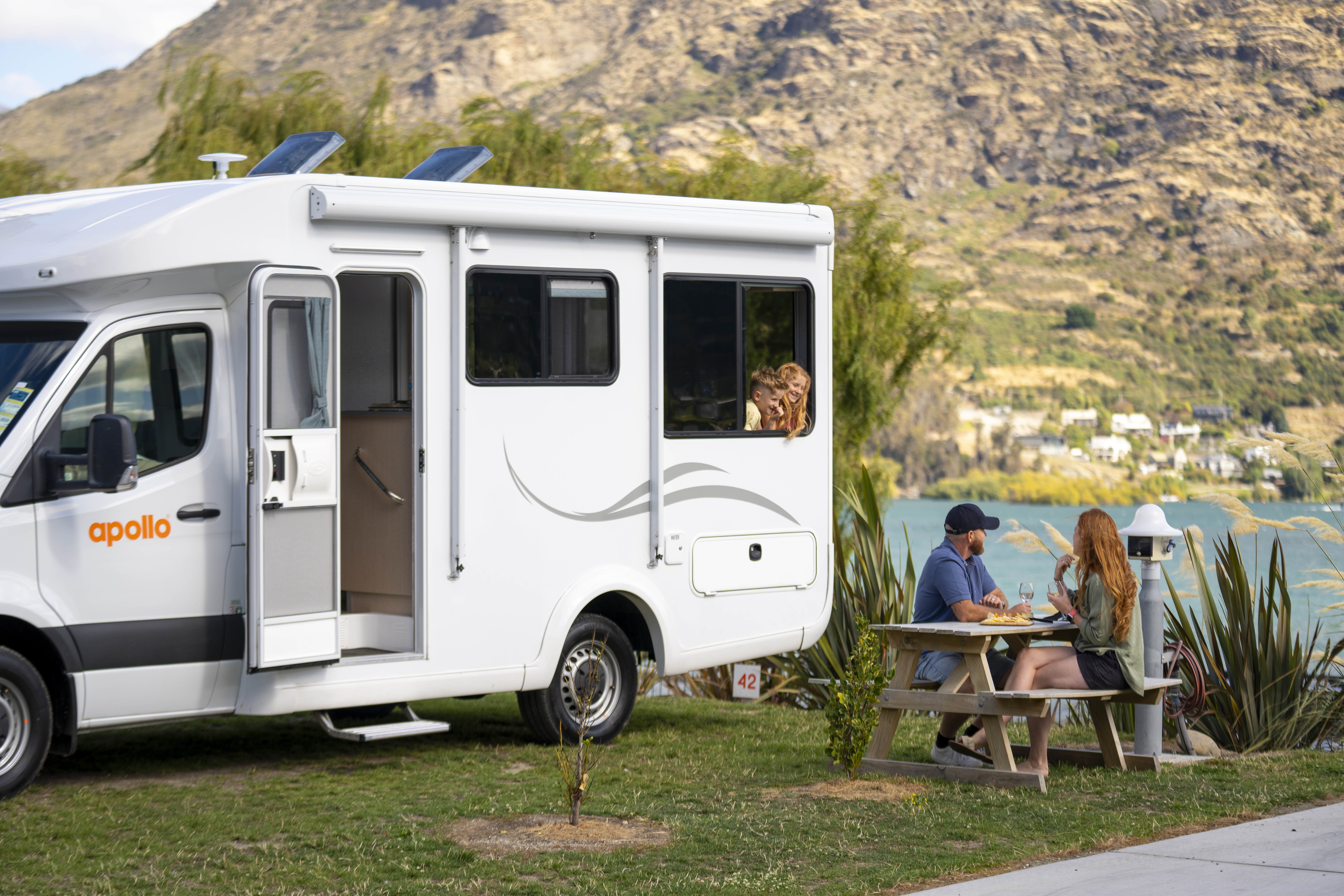
Step by step: RV reversing into a campsite
Here’s how to reverse a campervan into a campsite in 10 simple steps:
| Step | Key Tip |
|---|---|
| 1. Secure the campervan | Close and secure drawers, cupboards, doors, hatches, fold-out side steps and any loose items before moving. |
| 2. Walk around the site | Check for rocks, posts, tree roots, tables, bikes and other obstacles, including low branches or overhead hazards. |
| 3. Check your space | Make sure there's enough room for your campervan's height, width and length, plus the front swing when turning. |
| 4. Plan your approach | Choose the simplest line into the pitch (campsite) and avoid reversing farther than necessary. |
| 5. Use a spotter | If you have help, agree on clear signals and make sure you can always see your spotter. If you lose sight of them, stop. |
| 6. Check mirrors and camera | Use your mirrors, reversing camera (if the campervan has one) and your own observations together. Keep scanning rather than focusing on one view. |
| 7. Reverse slowly | Move at a slow walking pace and use small, gentle steering corrections. |
| 8. Stop if unsure | If the angle looks wrong, an obstacle appears or you lose track of your surroundings, stop and reassess. |
| 9. Park securely | Once positioned, come to a complete stop, select park or the appropriate gear, and apply the handbrake firmly. |
| 10. Take extra care on slopes | Keep the foot brake controlled, park securely and if unsure, ask campground staff for help. |
Reversing into a campsite can feel much easier when you break it into a simple routine. Rather than trying to do everything at once, pause, check the area, and then move in small, steady stages.
Start by stopping before the pitch and preparing the campervan. Check again for loose items inside, and make sure drawers, cupboards, doors and hatches are shut and secure. You also want the area around the vehicle to be predictable before anything starts moving.
Next, get out and walk around the campervan. Look at the space you are reversing into, but also check the route leading into it. Scan for rocks, low posts, tree roots, fences, picnic tables, power poles, guide ropes, bikes, toys and anything else that could sit below mirror height or near the wheels. Then look up. Campsites often have low branches, signs and roofline hazards that are easy to miss from the driver’s seat.

As you walk around, think about your campervan’s dimensions. Check the available width of the pitch, the length you need, and the overhead clearance. If your campervan displays its height where you can see it from the driver’s seat, keep that number in mind. It is especially useful in holiday parks with trees, car park style entrances, or covered service areas. Even if the rear looks clear, the height and front corner swing can still catch out new drivers.
Once you have checked the space, choose your line into the site. A good setup makes the actual reversing much simpler. If possible, position the campervan so you do not need to reverse any farther than necessary. Reversing into the pitch can also make departure easier later because you can drive out forwards with better visibility.
If someone is available to help, now is the time to use a spotter. Agree on simple signals before you start. Make sure your spotter stands where they can see you clearly and where you can see them clearly in your mirrors or through the window. They should stay well clear of the vehicle’s path, not directly behind it. If at any point you lose sight of your spotter, stop immediately and do not continue until you have re-established clear communication.
Before moving, check your mirrors again and clean the reversing camera lens if needed. A dusty or wet lens can distort the view and make judging distance harder. Use the mirrors to monitor both sides of the campervan and the front corners, and use the camera to help with the rear. Keep looking around rather than focusing on one screen.
When you are ready to begin, keep your foot brake applied, take off the park brake, put the vehicle into reverse and slowly reverse. The safest pace is a slow walking speed. Give yourself time to steer gently and make small corrections. Reversing too quickly can make it harder to judge the angle, notice hazards, or stop smoothly when needed.
As the campervan moves, keep scanning. Check the left mirror, the right mirror, the camera if fitted, your spotter if you have one, and the space near the front corners. This matters because the rear is not the only part that moves into danger. As you turn, the front of the campervan can swing outward, which is why so many new drivers clip a post or branch with the front corner while concentrating only on the back.
If the angle starts to look wrong, stop. If a child runs through the campsite, stop. If a cyclist appears, stop. If you are no longer sure where the rear wheel is tracking, stop. Reversing a campervan safely is about pausing, reassessing and continuing only when the path is clear.
Once you are in position, bring the campervan to a complete stop, put the vehicle into park (all Apollo vehicles have automatic transmission), and apply the handbrake firmly. Take a moment to confirm the vehicle is stable before anyone gets out or you begin setting up camp.
If the campsite is on a slope, add a few extra precautions. Reverse very slowly, keep the foot brake under control while positioning the vehicle, and do not rely on the accelerator to hold you in place. After parking an RV, apply the handbrake firmly, and put the vehicle in park. It is recommended to always park on a level campsite whenever possible – if you're unsure, speak to the staff at the campground who can help you select an alternative campsite if available.
Common first-time mistakes
The most common mistake for first time campervan drivers is relying only on the reversing camera. Cameras are useful, but they do not show every angle, they can make distances look different, and they are no substitute for checking mirrors, blind spots and the area around the vehicle. A camera should support your view, not replace it – plus, not all Apollo campervans have a reversing camera, so it's best practice not to rely on this.
Another frequent mistake is skipping the walk-around. It is easy to assume the pitch is clear, especially if you have already driven past it once, but campsites change quickly. A bag, a child’s scooter, a low branch or a newly parked car can turn a simple reverse into a costly one. Getting out for a proper look is one of the easiest ways to avoid trouble.
Many new drivers also focus only on what is directly behind the campervan and forget about front swing. When you turn the wheel while reversing, the front corners move too. That means a branch, fence or neighbouring vehicle near the front can become a problem even if the rear has plenty of room.
Moving too quickly is another classic error. A campervan is not a vehicle you want to rush. Large steering inputs, sudden corrections and reversing too fast usually make the angle worse, not better. Slow speed gives you time to think, check and stop if needed.
Other easy-to-miss mistakes include forgetting to lock drawers and cupboards, failing to check overhead height, using unclear spotter signals, continuing after losing sight of the spotter, and reversing farther than necessary. On a slope, another common issue is assuming the handbrake alone is enough once parked. Depending on the vehicle and surface, you may also need the right gear or park position and extra measures such as wheel chocks.
FAQs and quick answers
Do I need a spotter?
A spotter is not always essential, but it is very helpful when rear visibility is limited or the campsite is tight. If you use one, agree on clear signals first and stop immediately if you lose sight of them.
What if there’s no reversing camera?
Use clean, well-adjusted mirrors, get out and check the area behind and around the campervan, and reverse very slowly. If possible, ask someone to guide you from a safe, visible position.
How do I reverse on a slope?
Keep the foot brake under control, move slowly, and avoid letting the vehicle roll freely. Once parked, apply the handbrake firmly and select the correct gear or park position. If you’re unsure, ask campground staff for help.
Should I reverse into a campsite pitch or drive forwards?
The best option depends on the layout and what gives you the clearest, safest manoeuvre. Reversing in can make leaving easier later because you can drive out forwards with better visibility.
How do I know how much space the campervan needs?
Check your vehicle’s height, width and length before you start. Remember to allow enough room for mirrors, turning space and front swing as the campervan angles into the pitch. The friendly team at the branch will show you around your campervan when you pick it up – including where the vehicle height sticker is located on the inside of the windscreen.
What should I do if I lose sight of an obstacle or spotter?
Stop immediately. Apply the brake, reassess the area, and only continue once you can clearly see the route and understand exactly where the hazard or helper is.
Knowing how to reverse a campervan safely comes down to a simple routine: check your surroundings, secure the vehicle, know your dimensions, use your mirrors and reversing camera, ask for help if available, and reverse slowly. If visibility becomes unclear at any point, stop and reassess before continuing.
Reversing a campervan safely comes down to a simple sequence: stop, look around, secure the campervan, check your dimensions, use your mirrors and camera aids, ask for help if it is available, and reverse slowly. If visibility becomes uncertain at any point, stop and reset.
When you’re ready, you can easily book your Apollo camper online and pick it up from your closest Apollo branch in Australia or New Zealand before hitting the road.
